There's a lot of guilt involved in mothering - not least when it comes to how and what we feed our babies. A constant tension among breastfeeding advocates is ensuring that mothers are getting the information they need to make the right decision for their babies, while respecting their authority as parents and not devaluing their experience. It's heavy emotional stuff - and never straightforward.
For some out there, enough has been said about breastfeeding - anything further is meant to guilt and shame mothers into making the consensus choice. I have trouble with this on a number of fronts.
First, the notion that every new parent knows about breastfeeding and the risks of formula is absurd to anyone who spends any time discussing these issues with mothers. Front-line contacts from obstetricians to nurses to family doctors and pharmacists ought to be the foundations for good decisions, but too often they provide information that is out of date, coloured by their own professional bias or simply incorrect. Mothers need accurate information about the importance of breastfeeding and how to maximize chances of success: somewhat by definition, this means being clear about the consequences of not breastfeeding.
Second, while I believe strongly that a woman must determine the use of her own body, the 'personal choice' argument isn't quite so strong to me when it comes to breastfeeding. A mother who has chosen to birth and raise her child takes with that joy a burden of care - a child isn't owned, she is entrusted. Every baby deserves to be breastfed - as parents, we do countless things that are hard, uncomfortable and intrusive to care for our babies and children. Breastfeeding through challenges is no different than enduring the aches, pains and indignities that pregnancy brings - except that the pay-off is immediate.
Third, because breastfeeding is the biological norm, practices that encourage breastfeeding are good for babies and mothers whether they are ultimately successful at breastfeeding or not. Birth practices that empower women to remain in control of their bodies and their babies, engaging experienced empathetic attendants and post-partum care that recognizes the unique mother-baby dyad are the first steps to avoid many of the problems that lead to frustration and failure of breastfeeding relationships. But they are also the first steps to nuturing the mother so that she can in turn nuture her baby and feel confidence in her competence in that new role.
Advocates for breastfeeding whether health care professionals, volunteers or simply interested parents end up taking a lot of flack that's largely undeserved. We don't get any kind of bonus for helping a mother to breastfeed, spending hours encouraging her or researching a particularly thorny issue. Nor, to my knowledge, are there any posses hunting down formula-feeding mothers in public places to shame them or door-to-door solicitors trying to recruit pregnant women. There are many more mothers needing help and support than public health departments, clinics and La Leche League volunteers can help - they don't need to hunt them down.
Why don't we focus our collective energies on supporting mothers so that their pain and guilt can be avoided entirely?
 Adiri Nurser: Yeah, so just because it looks like a breast does not mean that it is anything like a breast. Babies don't develop nipple confusion because bottles don't look like boobies, they develop it because the mechanics of bottle-feeding are completely different from those of breastfeeding. Period. Save yourself the very expensive cost of these (apparently leaky) bottles.
 Car Seat Carrier: There are so many ergonomic problems with carrying a swinging infant car seat that I don't think we even need to address the fact that car seats are meant for transporting babies in cars and there's an increasing understanding of the dangers of leaving babies in seats for extended periods. To say nothing of the potential stress something like this might place on the seats. Just pick up you baby and check the seat.
 Udder Covers: While I'm all for anything that helps breastfeeding moms, I can't accept that referring to my "udders" is anything less than stupid and demeaning. Same with Hooter Hiders. The one plus is that these loud, graphic patterns do bring attention to how many moms are breastfeeding out there - which is something you can miss when they just pull up their t-shirt and their baby nurses.
 Baby Bling Pacifiers: Multiples issues here - first, what about a beautiful, angelic baby screams stuff a loud, sparkly plug in my mouth? Second, given that it is in a baby's mouth, are all these nooks and crannies really hygenic? And isn't it insane to spend $20+ on something that you are nearly 100% sure to lose?
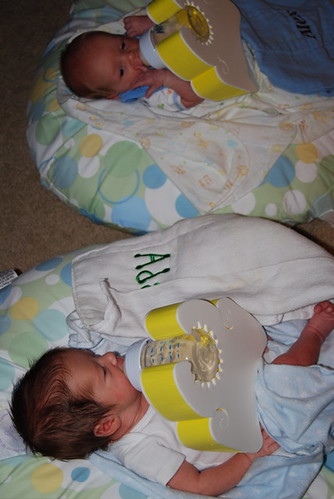 Milk Maid Bottle Holder: With everything we know about human attachment, how is it even legal to sell these things? Put aside the obvious safety concerns with leaving an infant like this - this is inhumane. The 'argument' I've seen in favour of these is that they allow parents of multiples or parents with disabilities to feed their babies without extra help. I don't buy it - if an infant can't be fed with love, then you need human hands to help, not these.


 Posts
Posts


